
Every online deal starts with the same question: who goes first? The buyer doesn't want to pay for something that might never arrive. The seller doesn't want to deliver work that might never get paid for. Platforms sit in the middle and absorb the fallout, from chargebacks and support tickets to users who quietly stop coming back.
We started Pandascrow in 2018 to take that question off the table. Our mission is simple: to power trust at scale. For most of our history, that meant helping freelancers, clients and online sellers transact safely through our dashboard. Today, more and more of that trust runs through the Pandascrow escrow API, built directly into other people's products.
This post is a progress report for partners and developers: what the escrow API does today, what we've strengthened this year, and where we're going next.
Why we're building escrow as infrastructure
When we looked at how money moves in African digital commerce, the pattern kept repeating. Marketplaces, freelance platforms, social sellers and property agents all hit the same wall: their users didn't trust each other enough to pay upfront. Each team ended up building its own fragile workaround, usually "pay half now, half later", or a manual hold managed in a spreadsheet.
Escrow solves this properly, but building it yourself means holding funds, handling disputes, reconciling payouts and staying compliant. That's months of work that has nothing to do with your core product. So we made escrow something you can plug in: your users get the protection of a neutral third party, and you keep building what makes your platform unique.
If you're still weighing escrow against direct payments, our earlier post on why direct bank transfers are risky for Nigerian businesses covers the business case.
What the Pandascrow escrow API supports today
Three escrow types for real-world deals
Not every transaction is a single payment for a single delivery, so the API supports three models:
- One-time escrow for a single exchange: an order, a gadget, a logo design.
- Milestone escrow for staged work. Funds are released one milestone at a time as each stage is approved, which suits software projects, construction and long freelance contracts.
- Recurring escrow for group or periodic payments, where several contributors pay into a shared cycle that's released when its conditions are met.
Each escrow records who pays the fee (the buyer, the seller, or both equally), and every escrow and milestone carries a full fee breakdown. You always know exactly what the buyer paid and what the seller receives.
Funding that fits how your users pay
Buyers can fund an escrow by card or through a dedicated virtual bank account generated for that transaction, so bank-transfer payments are matched to the right deal automatically. Payment links and invoices use the same rails, so you can add protected payments without rebuilding your checkout.
Release, disputes and payouts
When the buyer confirms delivery, completion is verified with a one-time code, and the seller is paid automatically: to their wallet, or straight to their bank account. Sellers can also receive payouts to mobile money or crypto accounts. If something goes wrong, either party can raise a dispute and the funds stay locked until it's resolved.
This year we rebuilt the completion flow to guard against double payment. If a release request is sent twice, by a double-click or a retried network call, only one payout goes through. For a payments product, that's the bug you never want to ship.
Webhooks you can trust
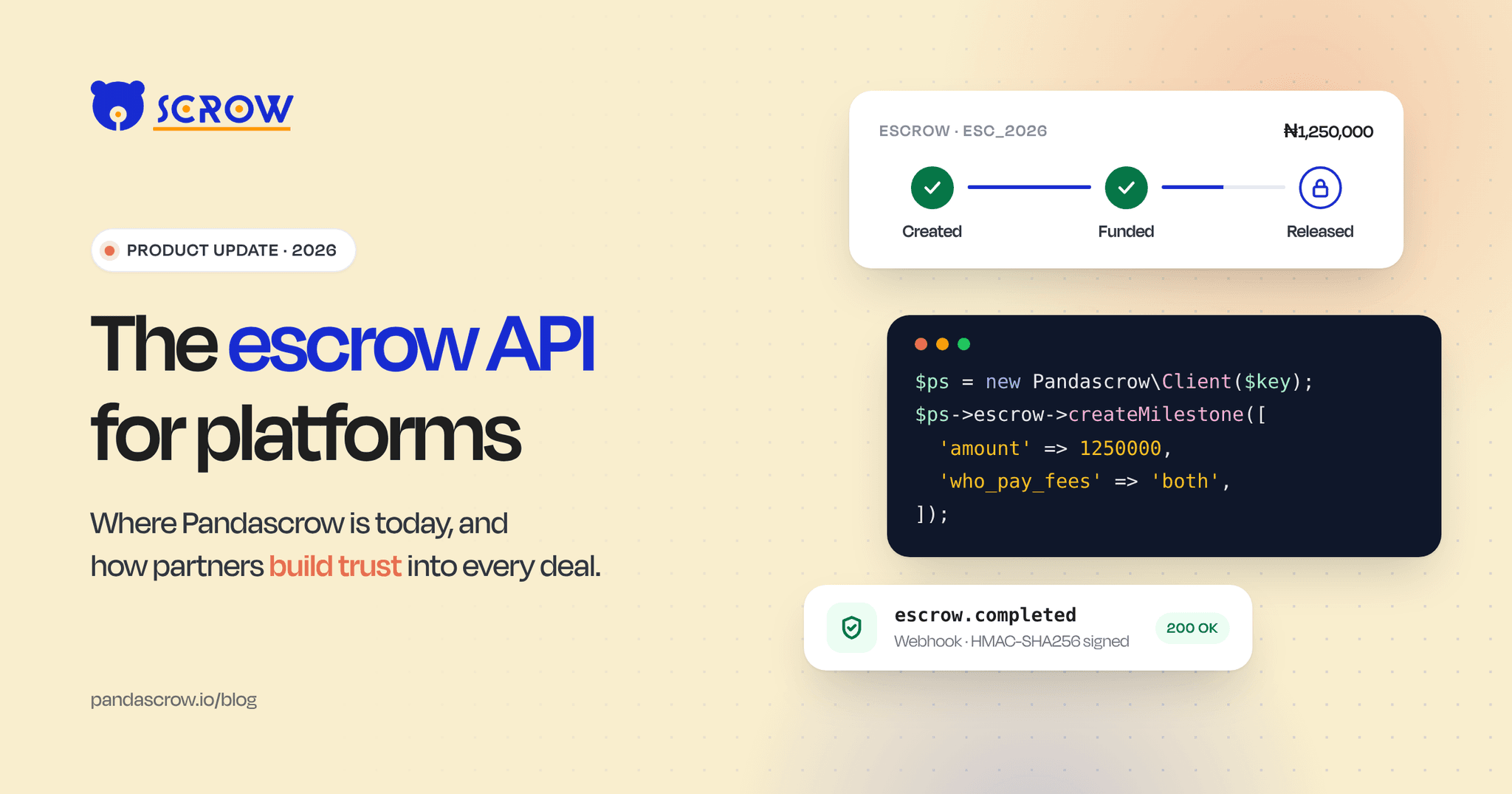
Your system shouldn't have to poll for changes. Pandascrow sends webhook events at the moments that matter, including escrow.created, escrow.milestone.completed, escrow.completed, escrow.dispute.opened, invoice.paid and wallet.deposit.success. Every event is signed with an HMAC-SHA256 signature in the X-Pandascrow-Signature header, so you can verify it really came from us before acting on it.
A sandbox and SDKs to build faster
You can build against a full sandbox before going live. Our PHP SDK covers escrow, wallets, bank transfers, virtual accounts, invoices, payment links and KYC lookups, and handles webhook verification for you:
$ps = new Pandascrow\Client($apiKey, ['sandbox' => true]);

// Verify an incoming webhook before you trust it
$event = Pandascrow\Webhook::verify($secretKey);
There's also a command-line tool for creating and managing escrows straight from your terminal. The full reference lives in our API documentation.
How partners earn with Pandascrow
Platforms that bring transactions to Pandascrow can earn from them. Partners can set a partner fee on escrows that flow through their integration, and it's paid out automatically when the escrow completes, alongside the seller's payout. The fee shows separately in the breakdown, so buyers, sellers and partners all see exactly where every naira goes.
On the identity side, the API includes lookups for Nigerian KYC checks such as BVN, NIN and CAC registration. That means you can verify who's on each side of a deal without stitching together another vendor.
Security work we finished this year
Trust infrastructure has to be secure by default, so a lot of this year's work happened behind the scenes:
- Passkeys: users can sign in with Face ID, Touch ID or a security key instead of a password.
- Authenticator-app two-factor authentication, with recovery codes for lost devices.
- Session controls: users can see every device signed in to their account and sign out any of them remotely.
- Safer logging: passwords, one-time codes and tokens are now masked in our logs automatically.
None of these are flashy features. They're what makes it reasonable to hold someone else's money.
What's next
The trust problem doesn't stop at borders, so the next phase is about reach and depth:
- More currencies and payout routes, so cross-border deals settle the way the recipient prefers.
- Automatic webhook retries and delivery logs, so a brief outage on your side never means a missed event.
- More SDKs beyond PHP, so you can integrate in the language your team already uses.
Our goal is for secure transactions to stop feeling like an extra step. They should simply be there, working behind every deal on every platform that uses Pandascrow.
Build with the Pandascrow escrow API
If you run a marketplace, a freelance platform, a social commerce app or any product where strangers pay each other, escrow can remove your biggest source of friction. Explore the developer page, read the API docs, or see how Pandascrow escrow works step by step. To talk about a partnership, email partnership@pandascrow.io.
We've spent the last eight years earning trust one transaction at a time. Now we want to help you do the same.